1 March – 31 October, daily 10:00 AM – 6:00 PM
68th Annual Exhibition 2024
EMIL NOLDE –
FANTASIES
EMIL NOLDE – FANTASIES
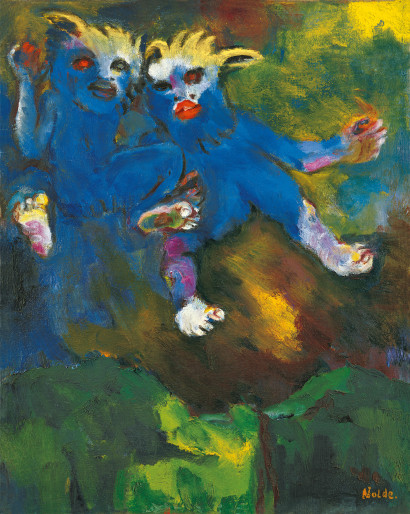
Emil Nolde, “Early Morning Flight”, painting 1940
© Nolde Stiftung Seebüll

About the exhibition

Under the theme “Fantasies,” the Nolde Museum Seebüll focused for the first time on a previously little-studied body of Emil Nolde’s work. Spontaneously and unconsciously, he painted curious creatures on canvas and paper throughout all phases of his career. Among them are both playful figures and ghostly, eerie beings.

Excursions into the dreamlike

Emil Nolde’s art is rooted in the German-Danish borderland of his childhood, where he found “the twilight, the fantastic of the North, these hours of fantasy excitement, in life and in art,” as he reported in his autobiography. He also understood his task as an artist in free invention.

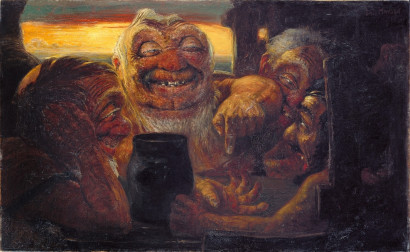
Since childhood, as Nolde himself recalled, he had a lively imagination: In the falling plaster of the cowshed, the boy recognized “faces and wild figures.” The farmer's son went his way as an artist despite many obstacles. With great success, he produced humorous depictions of the mountain world as "mountain postcards," the proceeds of which enabled him to start his career as a free artist. Even the first oil painting that Nolde, then still Emil Hansen, managed to wrest from himself awkwardly showed mythical "Mountain Giants" (1895/96), crude fellows in earthy brown. Fantasies and grotesques continued to run through his entire body of work from then on.

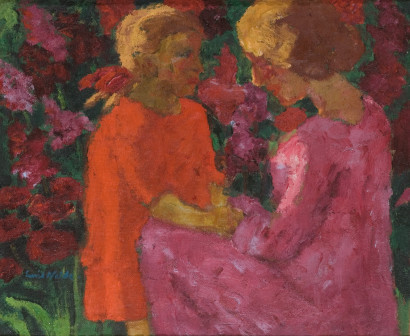
A woman in a pink dress kneels on the ground, holding the hands of a girl in a red dress. The background shows dark red flowers with green stems.
Emil Nolde, “Woman and Little Girl (II)”, painting 1918, Johenning Collection, Düsseldorf
© Nolde Stiftung Seebüll
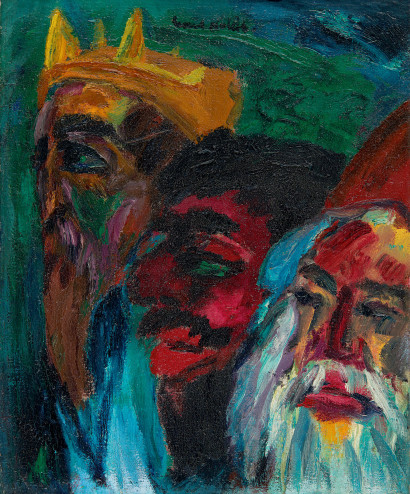
Three bearded male heads in profile, one wearing a crown, in front of a green-dark blue background.
Emil Nolde, “The Three Magi (Types)”, painting 1912, donation Professor Hermann Gerlinger
© Nolde Stiftung Seebüll

Following the artist’s life story, grotesque and fantastic series appeared at regular intervals. First in the graphic media, in which the trained woodcarver had great confidence, and from the 1920s onwards in watercolour, which Emil Nolde ultimately mastered with dreamlike sovereignty. The culmination of his watercolour work were the "Unpainted Pictures" – which, even without the myth spun around them for decades, testified to the ingenious power of the old Nolde.

In the “Fantasies,” he created a surreal, fantastic world that could hardly be grasped or explained in words. He painted his thoughts out in the truest sense of the word, on paper and canvas. Director Dr. Christian Ring, curator of the annual exhibition, further explained: “With the visualization of his fantasies, he let us participate in his inner world and opened up a completely new experience for us.”

The mature artist wrote diary-like notes, which he called "Words on the Edge." On 8 July 1943, he noted: "Excursions into the dreamlike, the visionary, and the fantastic were beyond rules and cool knowledge. They were free, wonderful realms and areas full of charm, buzzing with a light, deep, and subtle spiritual experience. Those who could not dream and see could not take part." Nolde knew that the “Fantasies” represented a challenge, that they were more difficult to open up than the motifs that had their origin in nature. This observation remained valid: The fantasies could be a welcome disruptive element. They broke conventions, sometimes humorously, sometimes drolly, but also frighteningly and profoundly.

Nolde wrote: "[...] wherever I looked, nature was alive – the sky, the clouds, on every stone and between the branches of the trees, everywhere my figures stirred and lived a quiet or wild, living life, which filled me with enthusiasm and also demanded to be visualized." In the exhibition, the fantasies from all phases of his artistic work and in all techniques were presented alongside luminous flower gardens, infinitely wide landscapes, roaring seas, and striking figure paintings. The 68th Annual Exhibition Seebüll 2024 showed this outstanding work in all its facets.

While the 67th Annual Exhibition Seebüll 2023 had been dedicated to “World and Home,” the exhibition “Emil Nolde – Fantasies” dared to take a different look into the world of fantasy. Thanks to his untameable imagination, the expressionist artist opened up new realms of thought for visitors.

Whether in books, films, or series, it had been clear since “The Lord of the Rings,” “Harry Potter,” or “Fantastic Beasts” that millions of people enthusiastically embraced fantastic worlds. Immersing themselves in a free and imaginative world, believing in a world of magic and wonder, opened the door to happy hours in a fascinating fairy-tale realm. With his painterly means and inexhaustible imagination, Emil Nolde enabled these blissful moments through his art.

Plan Your Visit To Seebüll

Plan Your Visit To Seebüll

Whether ticket purchase, arrival, parking options or the most frequently asked questions – here you will find an overview of the most important topics.

Insight Into The 68th Annual Exhibition

Four grotesque giants with white hair, beards, and partially missing teeth sit around a round table with a jug in the center. The background is an orange-coloured sky.
Emil Nolde, “Mountain Giants”, painting 1895/96
© Nolde Stiftung Seebüll
Three bearded male heads in profile, one wearing a crown, in front of a green-dark blue background.
Emil Nolde, “The Three Magi (Types)”, painting 1912, donation Professor Hermann Gerlinger
© Nolde Stiftung Seebüll
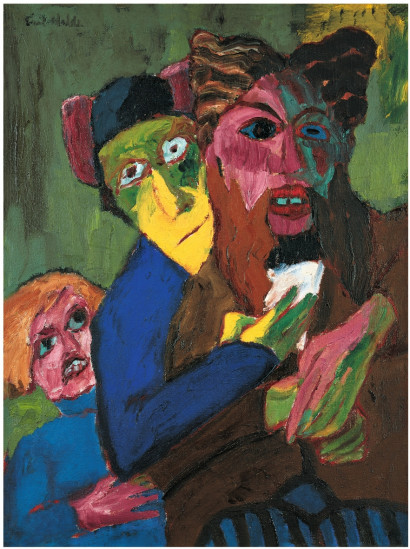
Three grotesque figures stand in a row; the middle one embraces the front figure. At the front is a bearded figure in brown, behind it a figure in blue with a yellow face and hat, followed by a smaller figure with a distorted face.
Emil Nolde, “Excited People”, painting 1913
© Nolde Stiftung Seebüll
A woman in a pink dress kneels on the ground, holding the hands of a girl in a red dress. The background shows dark red flowers with green stems.
Emil Nolde, “Woman and Little Girl (II)”, painting 1918, Johenning Collection, Düsseldorf
© Nolde Stiftung Seebüll
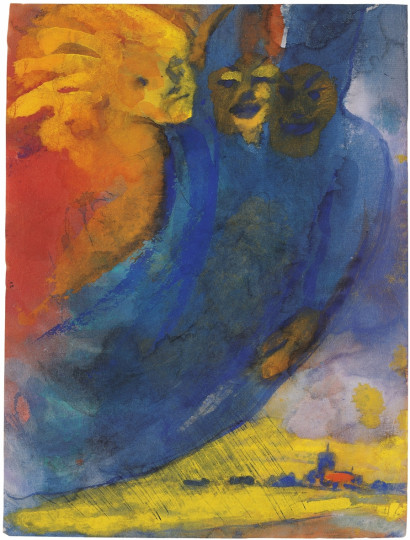
Three floating figures in yellow-orange and blue garments hover above a small town on a yellow surface.
Emil Nolde, Three Flying Figures over a City, watercolour
© Nolde Stiftung Seebüll
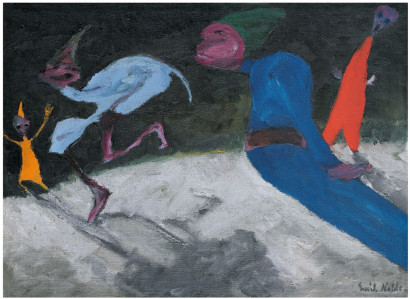
Four grotesque figures in colorful garments and pointed hats move across a bright, vaulted surface. The background is dark to nearly black.
Emil Nolde, “On the Periphery”, painting 1923
© Nolde Stiftung Seebüll
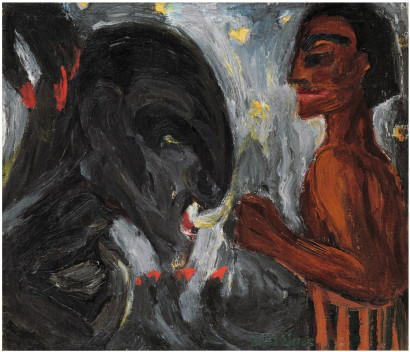
A black, eerie creature with red claws stands to the left of a dark-skinned man with a bare torso and black hair.
Emil Nolde, “Christ and Devil”, painting 1925
© Nolde Stiftung Seebüll
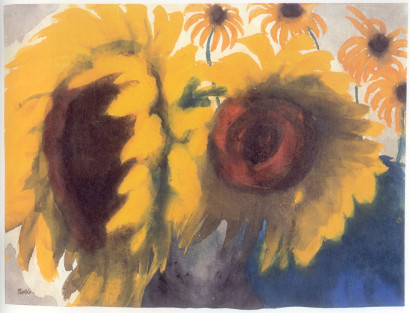
Two large yellow sunflowers in the foreground, behind them four yellow-orange rudbeckias.
Emil Nolde, Sunflowers and Black-eyed Susans, watercolour 1930/35, Johenning Collection, Düsseldorf
© Nolde Stiftung Seebüll
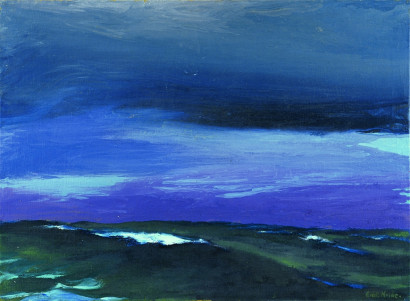
Dark sea with white foam crests under a blue-purple sky with scattered clouds.
Emil Nolde, “Sea and Sky”, painting 1937
© Nolde Stiftung Seebüll
Two grotesque creatures with blue bodies, yellow hair, and red eyes and mouths float in front of a green, yellow, and brown background.
Emil Nolde, “Early Morning Flight”, painting 1940
© Nolde Stiftung Seebüll