Winter break – From 1 March 2027 the museum will be open again
59th Annual Exhibition 2015
EMIL NOLDE –
MY LANGUAGE IS INDEED ART ITSELF
EMIL NOLDE – MY LANGUAGE IS INDEED ART ITSELF
Emil Nolde, Still Life (with Striped Goat), painting 1920
© Nolde Stiftung Seebüll

About the exhibition

With the 59th Annual Exhibition, “Emil Nolde – My Language Is Indeed Art Itself”, the Nolde Foundation Seebüll presented a comprehensive survey of the painter’s artistic work. In the former residence and studio, 142 exhibits from different areas and periods of his work were displayed, including paintings, watercolours, “unpainted pictures”, prints and painting utensils, as well as woven works by Ada Nolde. The exhibition explored Nolde’s understanding of art as a direct expression of his feelings and inner images. A particular highlight was the presentation of the 1920 painting Still Life (with Striped Goat), which the Foundation was able to acquire for its collection for the first time in two decades.

The exhibition offered insight into the intentions and motivations behind Emil Nolde’s artistic practice. For the painter, art was a language of its own, through which he expressed what moved him and stirred him inwardly. Many of his works emerged from his imagination, without a direct model or a predetermined intention. As a result, they resisted simple explanations and offered a range of possible interpretations.

Nolde regarded his paintings as carriers of feelings and experiences that were intended to affect the viewer directly. His art was not meant merely to be viewed or to provide entertainment, but to move and touch the viewer and convey a multifaceted impression of life and the human condition. The exhibition therefore placed active looking and personal engagement with the works at its centre.

Particular attention was given to the diversity of Nolde’s subject matter and forms of expression. Figure paintings, landscapes, floral motifs, religious subjects and still lifes demonstrated the distinctive character of his artistic language. The presentation made it possible to experience how the colour, expressive power and ambiguity of Nolde’s works continually opened up new ways of seeing.

Narrow strip of green meadow with a small red house on the right-hand side of the painting. Above it stretches a vast sky filled with numerous swirling white clouds. The sky is reflected in the water in front of the meadow.
Emil Nolde, Light Clouds, painting 1927
© Nolde Stiftung Seebüll
A man and a woman walk arm in arm along the seashore. They are walking on the beach. Green hills can be seen in the background beneath a light blue, almost cloudless sky.
Emil Nolde, Two on the Beach, painting 1903
© Nolde Stiftung Seebüll

One of the outstanding events of the exhibition year was the acquisition of the 1920 painting Still Life (with Striped Goat). After around 20 years, the Nolde Foundation Seebüll was once again able to acquire a painting by Emil Nolde for its collection. The work came from the estate of his second wife, Jolanthe Erdmann, and the acquisition was made possible with funding from the German State Cultural Foundation “Kulturstiftung der Länder”.

This exceptional figure still life brought together different objects and cultural references in a composition full of tension. A small Mexican bronze figure bearing a sun emblem and a striped goat were placed together on Nolde’s studio table. The work’s distinctive quality lay in its contrasting design, the powerful simplification of forms and its intense colour. The painting added an important example of Nolde’s figure still lifes to the collection and demonstrated his ability to unite seemingly opposing elements in a distinctive pictorial whole.

Alongside the new acquisition, seven other paintings were shown in Seebüll for the first time. The exhibition comprised 142 exhibits in total and offered new insights into the diversity of Nolde’s artistic work. Accompanying texts in the galleries provided visitors with further information about the works on display.

The Annual Exhibition demonstrated that Nolde’s art could not be understood through definitive explanations, but revealed its particular effect through direct experience and personal engagement. His paintings thus remained living testimonies to a distinctive artistic language, extending beyond the time in which they were created.

Plan Your Visit To Seebüll

Plan Your Visit To Seebüll

Whether ticket purchase, arrival, parking options or the most frequently asked questions – here you will find an overview of the most important topics.

Insight Into The 59th Annual Exhibition

Red poppies take centre stage, surrounded by orange and yellow lilies. Green stems and leaves complete the floral arrangement. The background is painted in various shades of violet.
Emil Nolde, Poppies and Lilies (Red and Yellow), watercolour
© Nolde Stiftung Seebüll
Two women at an open half-door of a house. One woman leans over the lower half of the door from outside. The other sits inside the house beside the door, looking down at an object held in her hands. The house is depicted in shades of yellow, green and brown.
Emil Nolde, By the Kitchen Door, painting 1907
© Nolde Stiftung Seebüll
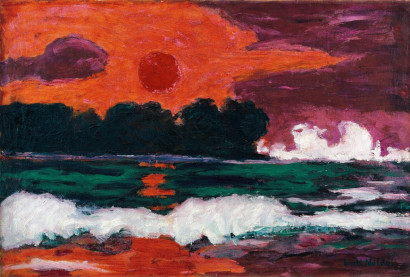
Dark green and black sea with a small wave and white crest in the foreground. Above it glows an intense red and dark red sky with a red sun. The vivid red tones are reflected in the sea.
Emil Nolde, Tropical Sun, painting 1914
© Nolde Stiftung Seebüll
Two brown horses stand on the left-hand side of a vast green meadow. Above them stretches a blue sky across which a large formation of white clouds is drifting.
Emil Nolde, Landscape with Young Horses, painting 1916
© Nolde Stiftung Seebüll
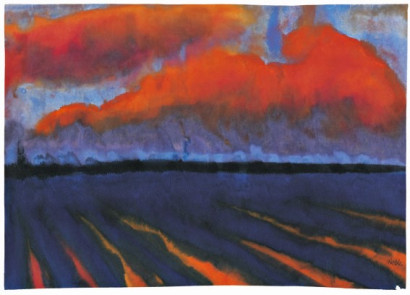
Landscape of fields in shades of violet, blue, black and red at dusk. Above them stretches a blue sky with large red clouds. A dark horizontal line marks the horizon.
Emil Nolde, Evening Landscape in North Frisia, watercolour
© Nolde Stiftung Seebüll
Portrait of a man wearing a white shirt and white jacket, with a blue scarf tied in a bow at the collar. He wears a beige hat with a black band and looks directly out of the painting with his blue eyes. The background is grey and white.
Emil Nolde, Self-Portrait, painting 1917
© Nolde Stiftung Seebüll
Two fantastical creatures are at the centre of the painting. The figure on the right has human-like features and wears a flowing black robe, from which only its yellow face and one yellow hand are visible. Beside it stands a child-like creature with a dark reddish-brown body, orange hair, forehead and nose. It stretches both arms upwards and looks towards the other figure. The background is orange, green, dark red and black.
Emil Nolde, Love is Blind, painting 1932 and 1939
© Nolde Stiftung Seebüll
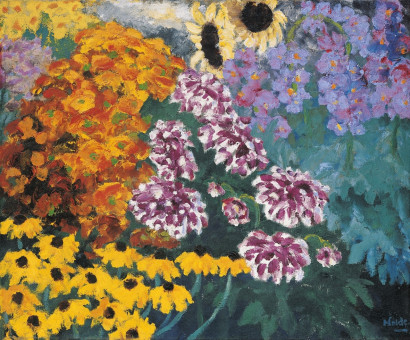
Dense floral arrangement featuring sunflowers, dahlias and other blooms in yellow, violet, white, dark red and orange. Green leaves and stems can be seen on the right. The flowers fill the entire painting.
Emil Nolde, Autumn Flower Garden (B), painting 1934
© Nolde Stiftung Seebüll
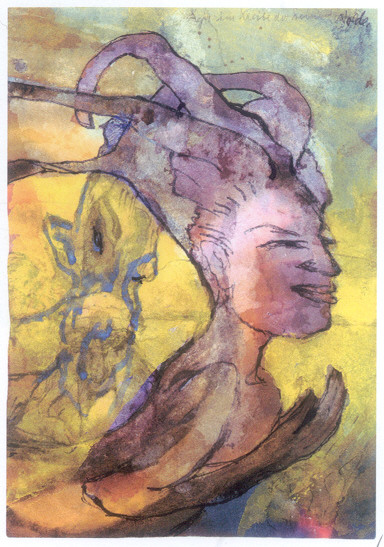
Abstract violet human figure with horns on its head, shown only from the waist up. The figure holds its right hand in front of its body and appears to be moving towards the right. Its upper body leans slightly forwards. The background consists of blended shades of yellow, blue and green.
Emil Nolde, Horned Violet Figure, watercolour
© Nolde Stiftung Seebüll
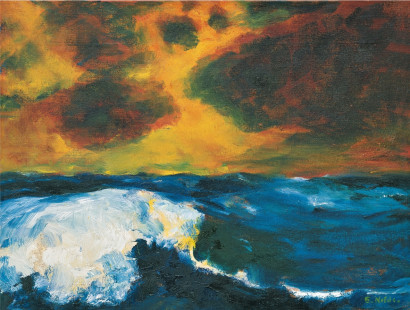
Blue and dark blue sea waves with a large wave and white crest in the foreground. Above them stretches a yellow-orange and brown sky with striking cloud formations.
Emil Nolde, Sea (III), painting 1947
© Nolde Stiftung Seebüll